A 13-Module Retraining Protocol for GLP-1 Users

The medication changed the signal.
Now retrain the system.

REWIRE™ is a structured audio course for GLP-1 users navigating the nervous system changes that accompany rapid physical change. Built on a four-beat rhythm your system already recognizes. Self-paced. Precise.

Enroll in the Pilot — $97 Pilot pricing $197

The body adapts fast.
The nervous system lags behind.

GLP-1 medications do what they're designed to do. But the behavioral, perceptual, and regulatory changes that follow are not part of the clinical protocol — and they affect nearly everyone.

01

Signal disruption after appetite suppression

When hunger signaling decreases, the reward systems that depended on it lose a primary input. The result is a gap between what your body does and what your brain expects.

02

Internal signal mismatch

Your internal prediction model was calibrated to a body that no longer exists. That mismatch registers as unease — a sense that something is off, even when the metrics are improving.

03

Nervous system compensation

When the body changes faster than the brain's model of the body, the nervous system compensates. That compensation shows up as anxiety, emotional flatness, sleep disruption, or instability.

04

Effort that doesn't hold

You try harder. You push through. You build routines. But nothing stays stable — because you're building on top of a system that doesn't feel predictable yet. The problem isn't discipline. It's foundation.

A rhythm your system
already recognizes

GLP-1 medications reduce appetite through central reward and signaling pathways. When that signaling shifts, internal clarity changes. The brain's model of the body falls behind its actual state.

When that gap opens, the nervous system compensates. That compensation is what most people experience as anxiety, flatness, instability, or a sense that something is off.

This is common. It is predictable. And it is trainable.

REWIRE™ doesn't ask you to try harder or track more. It teaches a four-beat rhythm — Arrival, Structure, Recognition, Release — that helps your system regain familiarity with itself. Not through effort. Through repetition.

The course starts with understanding what's happening and why. Then it introduces the rhythm. Then it helps you notice it in real life — until it becomes something you live with, not something you perform.

Applied Interoceptive Architecture™ Method

A structured method for restoring how the body's internal signals are processed — so that the system regains familiarity with itself, and steadiness replaces effort.

The Four-Beat Rhythm
Arrival Structure Recognition Release

13 audio modules. Three phases.

Understand what's happening. Learn a rhythm. Live it. The course moves from clarity to practice to integration — at your own pace.

00

Orientation

How the course works, what to expect, and how the workbook and journal fit together

01

What's Actually Going On

Naming the experience beneath the surface — why things feel harder than they should, even when you're doing everything right

02

Why This Happens

How interoception, nervous system load, and GLP-1 medication interact to change your internal signal landscape

03

Why the Way You've Been Trying to Change Stops Working

Why effort, discipline, and willpower fail when the system underneath isn't steady

04

Arrival

The first beat. Noticing where you are before anything else happens

05

Structure

The second beat. What's already holding — before you organize it

06

Recognition

The third beat. Registering that something shifted, without needing to understand why

07

Release

The fourth beat. When effort stops — not because something was solved

08

Living the Rhythm

The four beats as a system, not a sequence. How they work together without needing to be performed

09

How the Rhythm Shows Up in Real Life

When the rhythm is messy, partial, or invisible — and why that still counts

10

Emotions in Real Life

Emotions aren't the problem. Capacity is. How the rhythm changes what's available when feelings arrive

11

How Change Settles Over Time

When effort decreases, steadiness increases, and this workbook starts to feel less necessary

12

The Rhythm You've Been Building

The handoff. From course to journal. From learning the rhythm to living it

Print Materials Included

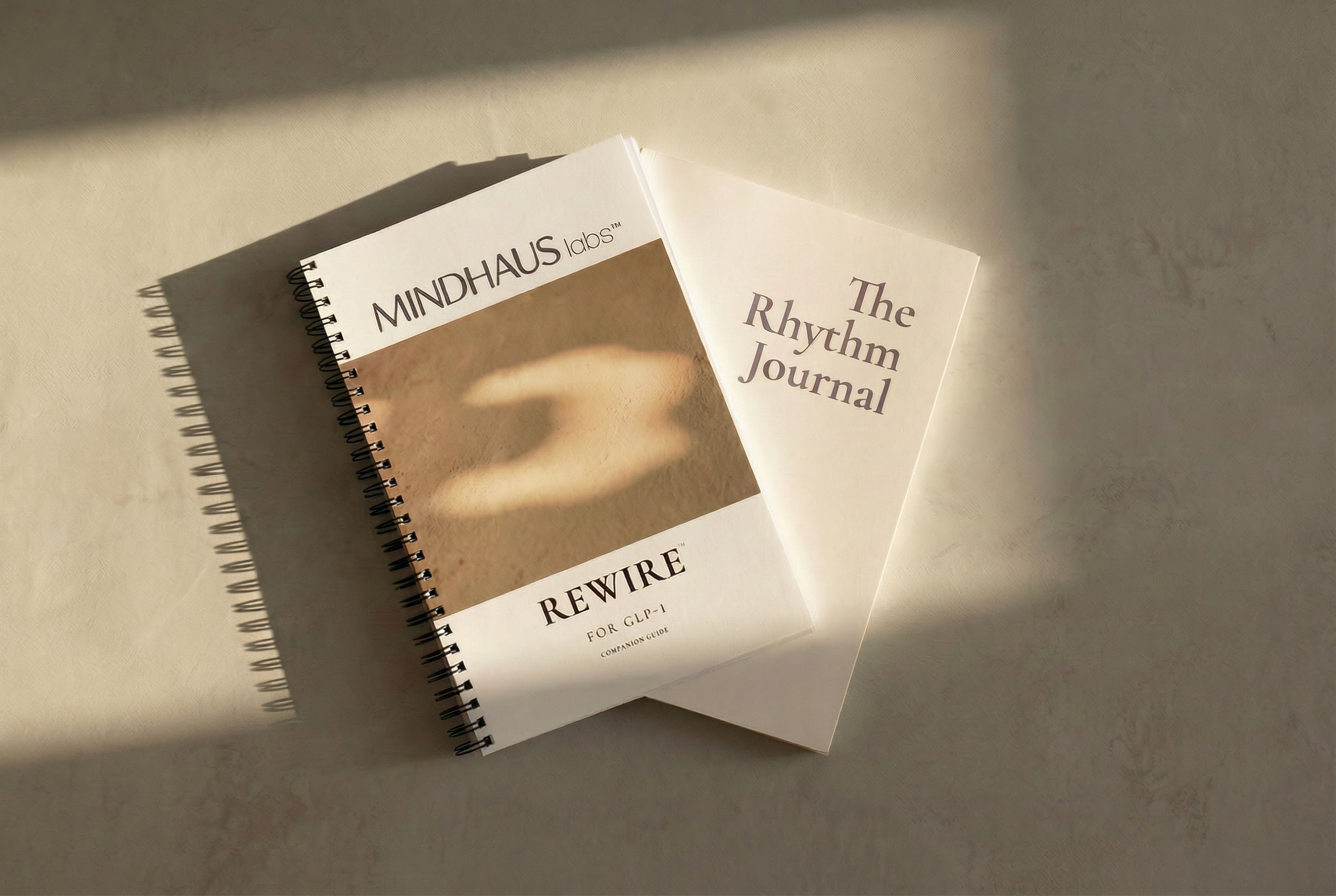
Companion Workbook — Pilot Print Edition. REWIRE Journal — Pilot Print Edition. The workbook teaches the language of the rhythm. The journal is where it lives afterward. Both ship with your enrollment.

Included

Founding cohort. Limited enrollment.

GLP-1 changes the body's signaling quickly. REWIRE™ helps the system that interprets those signals regain its rhythm. One addresses physiology. The other addresses everything that follows.

Founding Cohort

REWIRE™ Complete Course

Full course access, print workbook, print journal, and founding member pricing retained permanently.

$97 $197

One-time payment · Lifetime access

Enroll in the Pilot
Course Includes
13 audio modules (Modules 00–12)
Companion Workbook — Pilot Print Edition
REWIRE Journal — Pilot Print Edition
Four-beat rhythm framework for ongoing use
Lifetime access — including all future protocol updates
Founding member pricing retained permanently
Cohort Opens
March 2026
Cohort Size
75 founding members
Format
Fully self-paced
Recommended Timeline
6 weeks, 2 modules/week

Before you enroll

Who is this designed for?

+

REWIRE™ is built for anyone currently taking or recently starting GLP-1 medications (semaglutide, tirzepatide, or similar) who is experiencing changes alongside the physical shift. This includes things feeling harder than they should, energy or motivation becoming unpredictable, emotional reactions feeling sudden or outsized, sleep disruption, or a general sense that the body and mind are operating at different speeds.

Is this therapy or medical advice?

+

No. REWIRE™ is an educational course grounded in behavioral neuroscience. It is designed to complement professional care, not replace it. The content addresses nervous system regulation and behavioral structure — not clinical diagnosis or treatment. If you are in acute psychological distress, consult a licensed provider.

What does "pilot" mean in practice?

+

The course content is complete. "Pilot" means you are in the founding cohort, and your feedback will inform refinements to delivery, pacing, and supplementary materials. In exchange, you receive the course at founding pricing — locked in permanently, including all future updates and additions.

How is the protocol structured?

+

13 audio modules (numbered 00–12), fully self-paced. The course moves in three phases: understanding what's happening (Modules 00–03), learning the four-beat rhythm (Modules 04–07), and integrating it into real life (Modules 08–12). The recommended cadence is two modules per week over six weeks. You have lifetime access and can revisit any module.

Are there live sessions?

+

The pilot is fully self-paced with no live component. This is intentional — the course is designed for individual use at your own rhythm, not group participation. Future cohorts may include optional live integration sessions.

Limited to 75 Founding Members

The signal changed.
The system needs to follow.

You don't need more motivation. You need a rhythm your system can recognize.

Enroll — $97